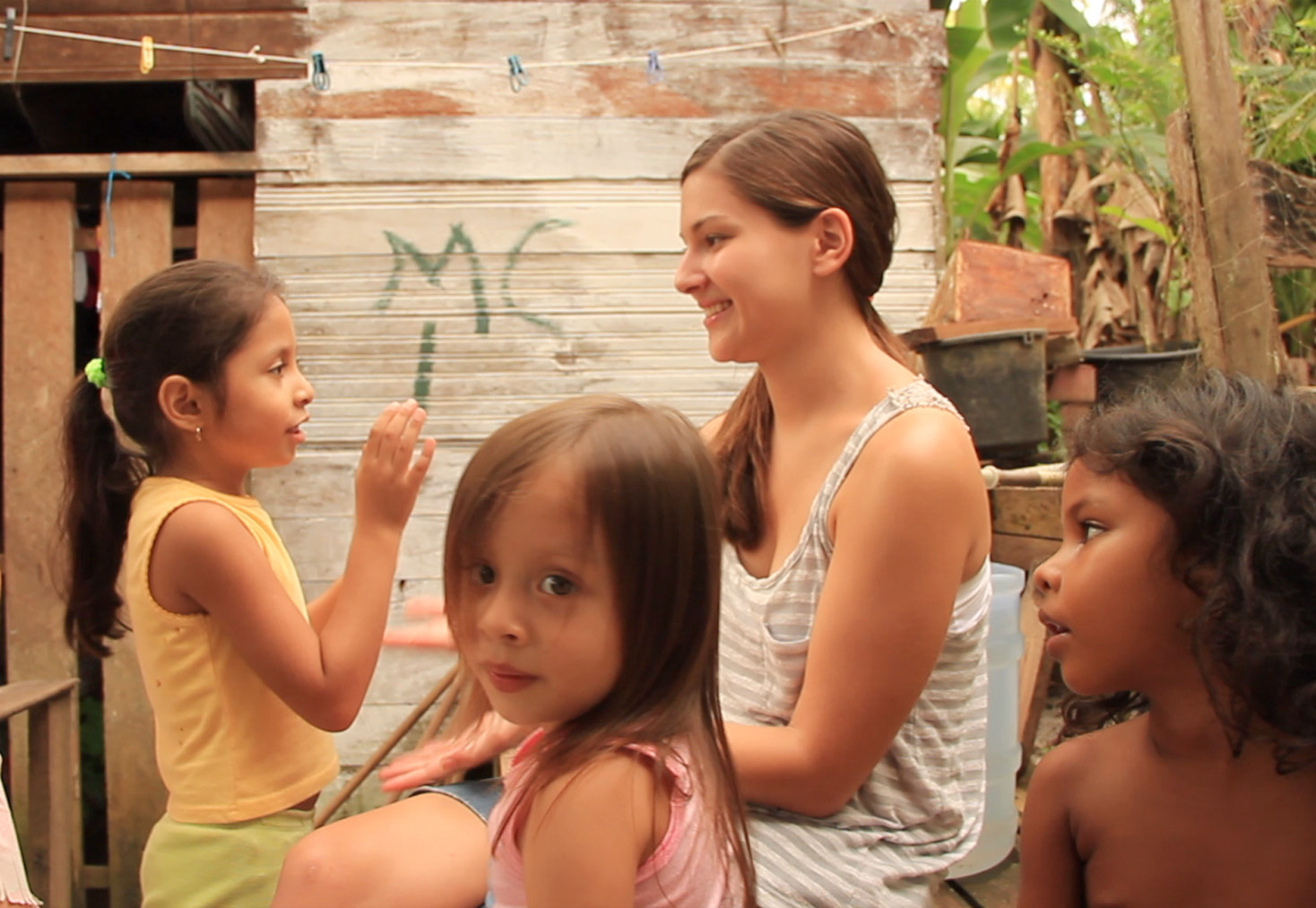
Camping. After this past week, the meaning of the word has lost its vigor to me. The action of camping outdoors, sleeping in a tent, roughing it – just the mention of the word was at one time so adventuresome to me. I thought it would be like camping, our venture into the interior. Only instead of a tent, I’d be sleeping in a hammock on a wooden boat. Instead of woods, I’d be in the middle of the Amazon rainforest. Instead of roasting marshmellows, I’d be eating rice and beans, rice and beans, rice and beans… and the occasional tropical fruit picked from the tree.
Our “camping” adventure of living on a boat for as days as we worked our way down the Amazon River turned out to be one of the most intense “roughing it” experiences I have had yet. And after the five days were over, as I dragged myself down the dock of Gurupa towards home, with mud-stained clothes, bruised legs, and a high fever, I couldn’t help but think how wrong I was comparing this trip to camping. I’ve never come back from camping with every inch of my body aching, from my toes to the gums of my teeth. But what it was… it was truly the most beautiful, refreshing, and indescribable five days. I had seen nature at its purest. And I was forever changed by it. This was the last thought I had before falling into a deep sleep that lasted for the next 26 hours.
How did it all begin? I knew we would be staying in Gurupa for three weeks, allowing my dad to do his anthropology research while I filmed interviews for the documentary we’ve been working on since last summer. Along with us for the trip was my mother, anthropologist Glenn Shephard, two Brazilian archaeologists, Joao and Carlos, and my dad’s student Kevin McDaniel. The town of Gurupa is remote, and at times has its comfort limits. The internet, on the rare days it is functioning in the town, is painfully slow at best. There are one or two home-run restaurants in the town and a couple of supermarkets – all of which are on their own schedule for opening and closing. The town is essentially smack in the middle of the Amazon rainforest, which comes with intense heat, swarms of mosquitoes, and a 3-hour boat ride upstream if you want to catch the newest flick at the movies. But even this tiny town that many people in the city of closest city of Belem have never heard of, is looked at as the “big city” to the people who live in the interior of the rainforest. By interior, I mean families that live in small wooden houses on stilts along the Amazon River. They have no need for motorcycles or cars – their only form of travel being wooden canoes or other small boats. Their closest neighbors are the tropical parrots, botos (fresh water dolphins), and coba grandes (giant snakes). Needless to say, they don’t go trick-or-treating for Halloween.
 |
| Little girl outside her house in the interior |
The interior rainforest, and these miniscule interior towns, was where we were headed with the crew. My dad had funded an archaeological expedition to search for sites within the interior. The archaeologists were going to be hiking through knee-high waters, cutting trees and brush with a machete, to search for signs of areas that might have ancient to prehistoric artifacts, dirt untouched by the hands of any archeologist thus far in history. The job of Glenn and I was to film it all, to interview the people who lived there – in short, to capture life in the interior on film. Sounds easy enough right? Flash forward to balancing on a fallen tree over a swamp covered with prickly plants, filled with who knows what creatures, a 10-pound camera strapped around my neck threatening to drag me down closer and closer to a scene from the movie “Anaconda.” But let’s start at the beginning…
 |
| Our boat/home for the 5 days that followed |
DAY ONE
As I walked on the dock toward the bobbing boat with the words FASE painted on the side, I wondered what this adventure would bring. I jumped into the side of the boat below, where I saw my dad already in his hammock – dead to the world. He had eaten some bad meat the night before, and was paying dearly with horrible stomach pains. The journey wasn’t off to a great start, we were already two hours behind schedule and the motor had decided to let us know it was tired of waiting by filling the boat with thick black smoke and a disheartening sputtering noise. Just as the smoke began acting as an unbearably hot blanket in the already stifling heat, the motor came to life and before we knew it we were puttering along the river, the cool wind blowing away the smoke and the unsteady bumping in the water swaying our hammocks gently.
 |
| Our hammocks hung in the boat |
After a few hours, the motor was cut off and we began floating slowly towards the dock of our first stop, a small wooden house seemingly in the middle of nowhere. The archaeologists had already jumped off the boat once we docked to ask the family inside if they knew of any sites nearby. I was getting my camera ready, and a thought ran across my mind. What if the families in the interior don’t want to be filmed? They surely don’t get too many foreigners in their house wanting to put a camera in their face. And my Portuguese-language skills were not anywhere near the level of accurately explaining the documentary we were making about the history and culture of the area. What if this all was for nothing?
I walked along the small dock and entered the house, and saw everyone sitting on the floor, with bits of what looked like straw or palm thatch scattered everywhere. There was an older woman sitting closest to the door, with a huge pile of plant stems surrounding her. She would take a knife, and cut and “X” onto the top of the thick stems. Then she would take two sticks, making another “X”, and slide them all the way down, cutting the stem into 4 thin strips. With these strips, she was weaving baskets. The way she weaved was so intricate and beautiful that I was itching to grab my camera, but I knew we had to ask permission first before filming. So my mother asked her if I could film, she looked at me, looked back at my mother, and said no.
Well there goes that, I thought. But since our documentary was apparently doomed anyway, I decided to at least enjoy the moment – so I grabbed an unfinished basket and began attempting to help the woman weave. This was much more difficult than I realized, as the strips began cracking and breaking in my clumsy fingers. The woman caught sight of what I was doing, and started laughing. My struggles with weaving amused her, so she decided to sit and teach me the proper way to do it. After a while I had finished almost half of a basket to her two, and she had allowed Glenn to film the process. When we left she jokingly offered me a job with her – little does she know that I’m adding “basket weaving” to my resume.
 |
| Learning from the best |
Later that night, I could not get to sleep. I was lying in my hammock, eyes wide open, staring into pitch darkness. It might have been that I was not used to sleeping in a hammock, and could not find a comfortable position. Or maybe the fact that I kept getting myself tangled in the mosquito net that hung above me. There were also the hundreds of animal noises coming from the darkness, none of which I could recognize apart for the exceptionally loud croaking frog that sounded as if it had hopped onboard. But most likely, what was keeping me up was the symphony of snores coming from all five anthropologists/archaeologists onboard. Either way, the hours went by and before I knew it, it was 5 AM and I was still wide awake. So since sleep wasn’t coming anytime soon, I decided to climb on top of our boat and watch the sun rise over the rainforest horizon.
I crept out to the front of the boat, trying to be quiet but every step made the old wooden boat creak and moan. It was enough noise to wake up my mother, who climbed out of her hammock too join me on the front of the boat. I began climbing the ladder to the top of the tin roof, my mother staying below due to a fear of heights, especially heights in pitch darkness. In mid-climb I looked up, and what I saw made me freeze, grasping onto the final step of the ladder.

Above, in the pitch-black sky, were thousands of brilliant stars stretching farther than my eyes could follow. And in the dark river below was a crystal-clear reflection of the starry night. I could pick out every constellation in the rippling water, like a mirror set purposely on the ground to double the intensity and the magnificence of the brilliant sight twinkling above. I sat there on top of the boat, legs swinging off the side of the cool tin roof, and tried to memorize every detail. The sun began to rise and the black sky turned dark blue, and the twinkling stars began to disappear one by one. The noises of the animals in the forest began to change from croaking frogs and buzzing mosquitos to early-morning parrots and woodpeckers. The comforting aroma of fresh Brazilian coffee brewing let me know the crew was awake, and it was time to begin another day in this beautiful place.
 |
| Watching the sun rise over the Amazon River from the roof of our boat |